Ester synthetic oil, why is it expensive? What are its advantages?
Ester oil is a popular type of high-end synthetic lubricant. It was developed by the Germans during World War II to solve the problem of cold-zone starting of tanks and locomotives. Later, it was widely used in aviation and other fields. Gradually, it was used in automobile sports. Let's talk about the boring synthesis from a chemical perspective. Ester base oil is made by catalytic dehydration of organic acids and alcohols. Commonly used are diesters, polyol esters and complex esters.
1.Ester fully synthetic motor oil, what makes it better?
Ester products contain various forms of oxygen atoms such as carbonyl oxygen and alcohol oxygen. This is the functional group that distinguishes ester synthetic oil from general mineral oil and has polarity. The base oil of three types of synthetic oil and PAO synthetic oil does not contain this group.
In the lubrication process, the ability to form a thick oil film between the friction pairs is critical to the lubrication effect. Compounds containing polar groups are more likely to adsorb on the friction interface to form an effective tough oil film. The same function is achieved by adding additives to non-polar synthetic oils. From the product description, you can see words such as diesters and alcohol esters. In fact, the synthetic raw materials are different, and the reaction mechanism is similar.
Diesters are esterified by dibasic acids and monohydric alcohols, or monobasic acids and dihydric alcohols. Polyol esters are formed by the reaction of polyols with straight-chain or short-chain fatty acids. Complex esters are esterified by dibasic acids and dihydric alcohols into long-chain molecules, and then the end alcohols or acids are esterified to finally obtain high-viscosity products. In terms of performance, the biggest advantage of esters is their wide liquid range and low-temperature flowability due to their flexible carbon-oxygen chains.
As for esters themselves, diesters have a lower viscosity and a higher viscosity index, and their pour points are generally lower than -60 degrees. Polyol esters have a higher viscosity than diesters, and their viscosity index and pour point are also lower than diesters. The 300V low-temperature start-up type is better than the red line, and the reason can be found from the molecular structure of the product (of course, additives are also an influencing factor). Due to their high viscosity, complex ester products are generally used as blending components to increase the viscosity of oil products.
Everything has two sides, and ester oil is no exception. Let's talk about the advantages first:
A. Good thermal stability. From the perspective of thermal decomposition temperature, diester oil is generally around 280 degrees, and alcohol ester exceeds 300 degrees. This is related to its molecular structure. The fully inhibited ester esterified with neopentyl polyol has a higher decomposition temperature.
B. The polar structure gives this type of oil a special lubricating performance, which is easy to adsorb on the interface to form a stable oil film. Even in the cold state, it will not completely reflux, providing good low-temperature protection. For example, compared with mineral oil lubricants, the polar functional groups of the ester group are like the suction cups of geckos that are attached to the friction pair interface, and are not easy to fall off even in the low-temperature cold state.
C. Strong sensitivity to additives. It can be well integrated and coordinated with antioxidant, anti-wear and other additives. The biggest disadvantage of ester oil is its hydrolysis stability and material compatibility. Because it contains polar groups, ester oil is easy to absorb moisture (remember to tighten the lid if you use it). Polyester is relatively stable to pure water, but unstable in acidic and alkaline environments.
Since engine oil contains many additives containing phosphorus and sulfur, and there are fine metal particles worn off during operation, the additives will produce acidic substances under metal catalysis, further catalyzing the hydrolysis of esters. Esters will have obvious swelling on rubber products of certain structures, which is also one of its disadvantages. However, these shortcomings are alleviated by appropriate modified additives.
What is the difference between ester synthetic oils?
Ester synthetic oil contains various forms of oxygen atoms such as carbonyl oxygen and alcohol oxygen, which makes ester synthetic oil different from the functional groups of general mineral oil and has polarity; while the base oils of three types of synthetic oils and PAO synthetic oils do not contain this group, which is the biggest difference between lipid synthetic oil and ordinary synthetic oil.
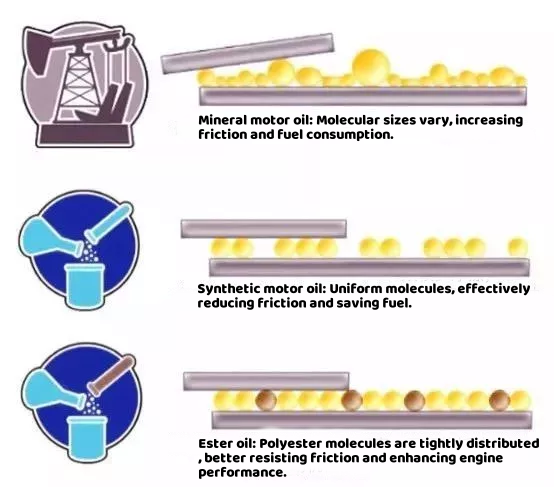
Active adsorption oil film and passive adhesion oil film In the lubrication process, the formation of a thick oil film between the friction points of the lubricating oil is critical to the lubrication effect. Compounds containing polar groups are more likely to be adsorbed on the friction interface to form an effective tough oil film.
The same function is achieved by adding additives to non-polar synthetic oil. It mainly adheres to the friction interface with a certain viscosity. This adhesion gradually flows back and falls off under the action of gravity as the engine stops working, and the oil film becomes very fragile. The oil film generated by chemical polar adsorption can be maintained for a long time after the engine stops, providing uninterrupted lubrication for the engine.
Advantages of ester oils
A. Good thermal stability
From the perspective of thermal decomposition temperature, diester oil is generally around 280 degrees, and alcohol ester exceeds 300 degrees. This is related to its molecular structure. The fully inhibited ester esterified with neopentyl polyol has a higher decomposition temperature.

B. Easy to adsorb and stable oil film
The polar structure gives ester oil a special lubricating performance, which is easy to adsorb on the interface to form a stable oil film. Even in the cold state, it will not completely reflux, providing good low-temperature protection

For example, compared with mineral oil lubricants, the polar functional groups of the ester group are like the suction cups of geckos that are attached to the friction pair interface, and are not easy to fall off even in the low-temperature cold state.
C. Strong sensitivity to additives
It can be well integrated and coordinated with antioxidant, anti-wear and other additives.